How India lost chip manufacturing due to license raj
In the 60s, Fairchild Semiconductors went to India because they wanted their first offshore manufacturer to be there. They wanted to produce 10 million transistors yearly, the government explicitly told them to produce only 600k. They decided to leave for Hong Kong.
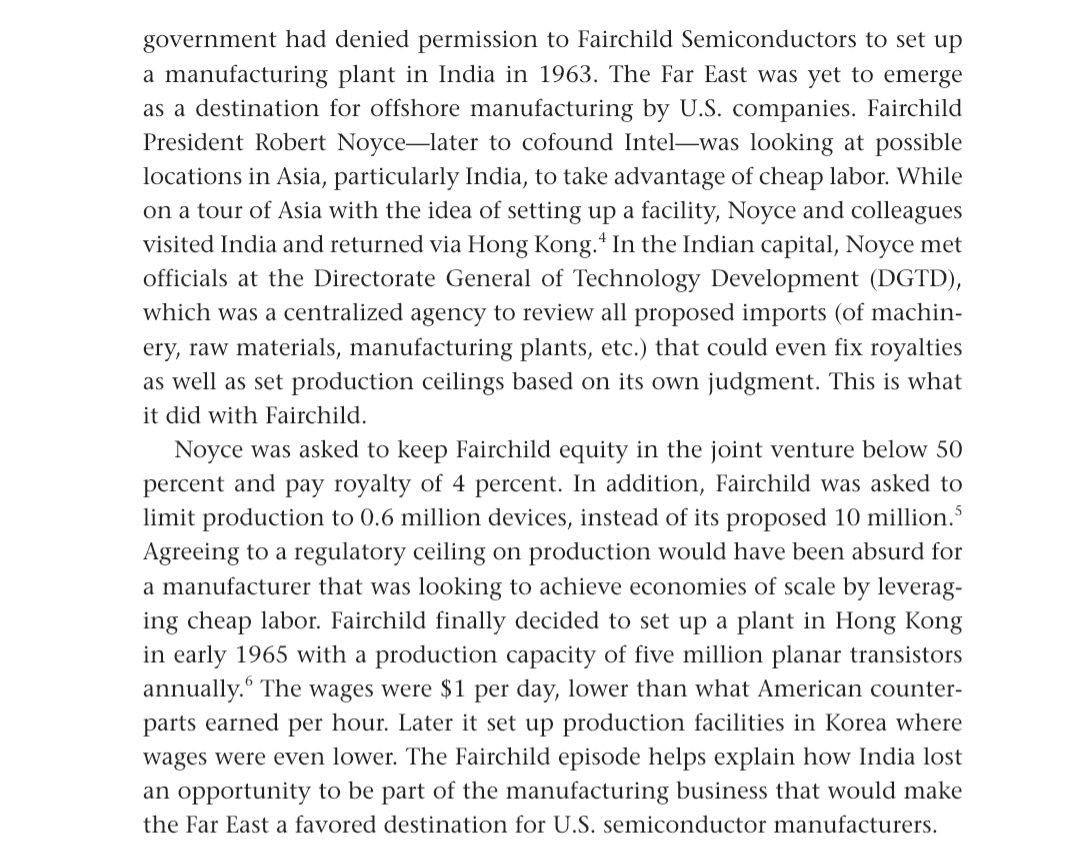
Sourced from The Outsourcer: The story of India (page 108)
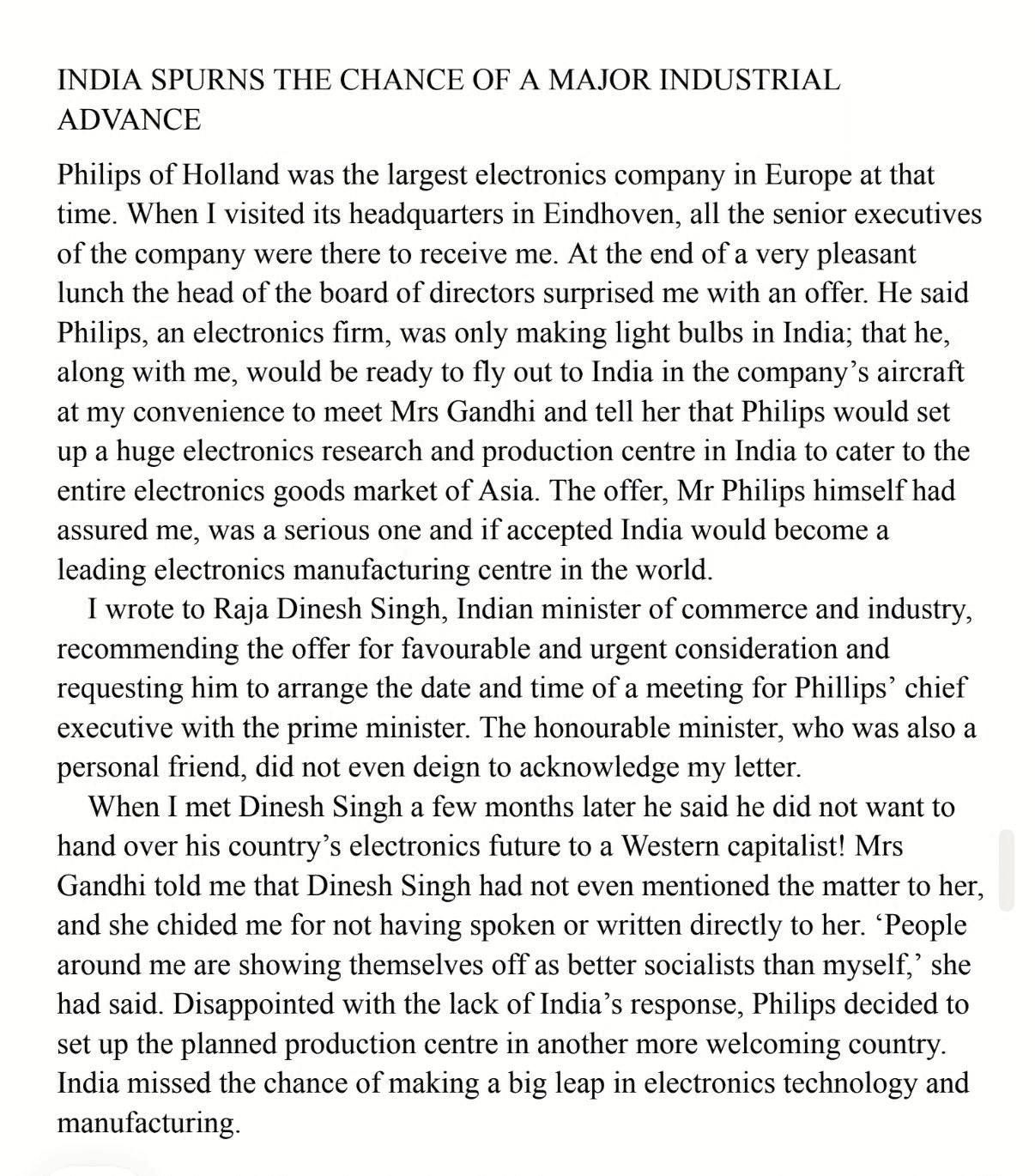
In his memoir, A Life in Diplomacy (page 351) Maharajakrishna Rasgotra points out how Indian politicial leaders refused an opportunity to become an electronics manufacturing hub in the 1970s.
Philips of Holland was the largest electronics company in Europe at that time. When I visited its headquarters in Eindhoven, all the senior executives of the company were there to receive me. At the end of a very pleasant lunch the head of the board of directors surprised me with an offer. He said Philips, an electronics firm, was only making light bulbs in India; that he, along with me, would be ready to fly out to India in the company’s aircraft at my convenience to meet Mrs Gandhi and tell her that Philips would set up a huge electronics research and production centre in India to cater to the entire electronics goods market of Asia.
The offer, Mr Philips himself had assured me, was a serious one and if accepted India would become a leading electronics manufacturing centre in the world. I wrote to Raja Dinesh Singh, Indian minister of commerce and industry, recommending the offer for favourable and urgent consideration and requesting him to arrange the date and time of a meeting for Phillips’ chief executive with the prime minister.
The honourable minister, who was also a personal friend, did not even deign to acknowledge my letter. When I met Dinesh Singh a few months later he said he did not want to hand over his country’s electronics future to a Western capitalist! Mrs Gandhi told me that Dinesh Singh had not even mentioned the matter to her, and she chided me for not having spoken or written directly to her. People around me are showing themselves off as better socialists than myself,’ she had said.
Disappointed with the lack of India’s response, Philips decided to set up the planned production centre in another more welcoming country. India missed the chance of making a big leap in electronics technology and manufacturing.
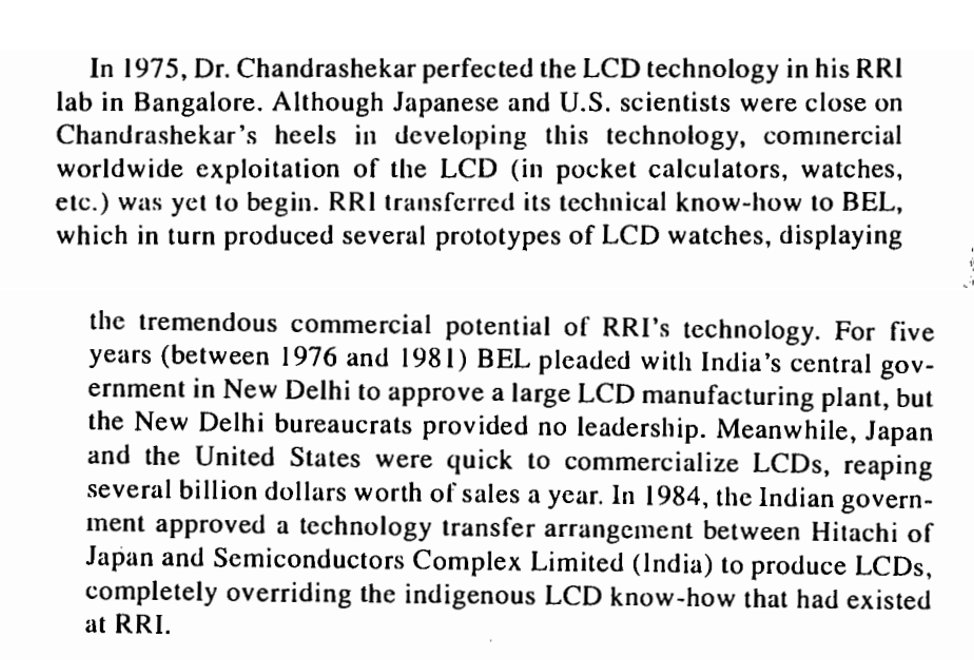
In 1975, Dr. Chandrashekar perfected the LCD technology in his RRI (Raman Research Institute) lab in Bangalore. Although Japanese and U.S. scientists were close on Chandrashekar’s heels in developing this technology, commercial worldwide exploitation of the LCD (in pocket calculators, watches, etc.) was yet to begin. RRI transferred its technical know-how to BEL, which in turn produced several prototypes of LCD watches, displaying the tremendous commercial potential of RRI’s technology.
For five years (between 1976 and 1981) BEL pleaded with India’s central government in New Delhi to approve a large LCD manufacturing plant, but the New Delhi bureaucrats provided no leadership.
Meanwhile, Japan and the United States were quick to commercialize LCDs, reaping several billion dollars worth of sales a year. In 1984, the Indian government approved a technology transfer arrangement between Hitachi of Japan and Semiconductors Complex Limited (India) to produce LCDs, completely overriding the indigenous LCD know-how that had existed at RRI.
Semiconductors Laboratory (SCL) began production in 1984 and was manufacturing 5000 nm chips, just one generation behind global standards at the time.
In 1989, an unexplained fire burnt it to ground. The rebuild happened slowly over 8 years. Taiwan’s TSMC took the lead in the meanwhile.
In 2005, SemIndia Inc., a consortium of Indian technologists, had planned to invest $3 billion in a wafer fabrication facility in India using technology licensed from AMD.
The AMD equipment was stuck in Indian customs. And due to mounting storage costs eventually forced the companies to send the equipment back to China. This caused India to miss an opportunity to build a semiconductor manufacturing base.
“The Indian government was a bit slow in coming out with its semiconductor manufacturing proposal and missed the window of our period of time that we had to commit our next tranches of manufacturing capacity. That is a fact. That is the story,” - Chairman Craig Barrett said in New Delhi.