Malik: from Jihad to reservation
This is a thread about the shocking history of Malik community of Bihar.
It documents how they transitioned from calling themselves proud Afghan Jihadi Syeds to availing benefits of reservation as downtrodden Muslim OBCs.
I show how a foreign elite which ruled India for 100s of years now avails reservation benefits. In doing so, they exploited a big loophole in the current Indian reservation system. Maliks of Bihar trace their ancestry from Malik Ibrahim Bayu and his tribe.
Malik Ibrahim Bayu was a Syed Sufi invader from Ghazni, Afghanistan. Syeds are considered the uppermost class among Muslims because they claim descent from the Prophet.
Malik Ibrahim Bayu became the Tughlaq army general and he, along with his tribe, defeated native Hindu kingdoms of Bihar. After crushing the Hindu kingdoms, the Maliks destroyed whatever was left of Nalanda.
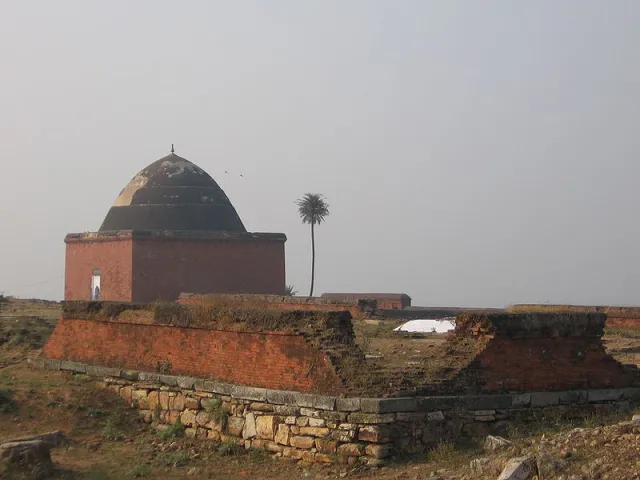
Today, Malik Ibrahim Bayu’s tomb lies on Nalanda ruins. It is directly built on top of Vihara remains and uses the bricks of the destroyed Vihara. In his archaeological survey, archaeologist Cunnigham confirms that Malik Ibrahim Bayu’s tomb was built on top of a Buddhist temple.
For the next 700 years, Maliks dominated the landscape of Bihar. From Babur to Aurangzeb, they functioned as Zamindars and Governors of the region. These Syed Maliks virtually ruled over Bihar for the next few hundred years under Mughal administration. Their rule was known to be extremely oppressive.
I will not go into the details so as not to digress. Suffice to say they maintained their dominance throughout this period. Maliks continued their domination throughout 20th century.
During the days of Independence, many Maliks supported Pakistan. As a result, Maliks occupied important positions in both Congress and Muslim league. Thus, the first Chief Minister of Bihar province was a Malik named Mohammad Yunus. Bihar State Congress president was a Malik named Abdul Bari.
After 1947, many Maliks left for Pakistan and occupied important positions there. One such Malik was ABA Haleem the first vice-chancellor of Karachi university. Until the Mandal Commision in 1990, the Maliks considered themselves and were seen as rich upper class Ashraf Muslim nobility.
But after the approval of Mandal commission report, the Maliks suddenly realized they are a “backward, oppressed” community.
In the 1990s, Maliks first requested the government to be included under the OBC category. So they filed a petition to the State Commission of Backward Classes of Bihar (Lalu’s government). The SCBC conducted a field survey. The results were revealing.
The literacy rate in Malik villages was over 90%. They all lived in Pucca houses. They abstained from working in the field and hired laborers from other lower castes to get their agricultural work done. The report also noticed the “cunningness” of Maliks.
They dropped the word ‘Syed’ from their official documents which is basically a marker of their nobility.
Every backward caste has a certain caste occupation. But in the case of Maliks, the applicant failed to name any specific caste occupation of theirs. Therefore, the SCBC rejected their application and notified the government. But the Maliks did not give up. They bided their time. They soon found their opportunity when Nitish Kumar became Bihar CM in 2005. Nitish Kumar had a point to prove to the Muslims that he was secular despite his alliance to BJP.
The Maliks exploited these political infirmities of Nitish Kumar. They once again knocked the SCBC.
This time they posed themselves as Telis (oil pressers), after Teli Maliks of Uttar Pradesh with whom they had no relationship whatsoever. Telis were oil pressers who claimed high Syed Malik status and called themselves Teli Maliks. The real Maliks exploited this to their advantage. This time, Nitish Kumar Govt. approved their claims. Finally, Upper caste Syed Maliks officially became OBC. This led to a huge uproar from Pasmanda Muslims as they felt the Syed Maliks were eating up their share of reservations. They accused Nitish Government of playing “Divide and rule” politics.
After years of protests and petitions, the Maliks were moved back into general category in 2011. However, this did not change anything at all. As the Malik now counted themselves under the Teli-Malik section.
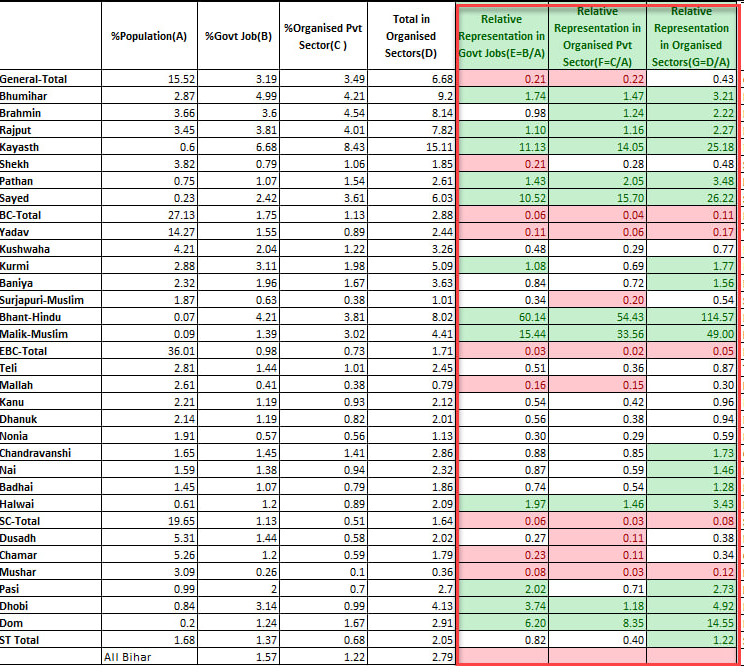
Therefore, the extremely affluent Malik community continues to enjoy reservations till date. The 2023 Bihar census exposed the absurdity of the entire matter. “Teli-Maliks” are 0.09% of Bihar’s population. But their relative representation in Government jobs is 16 times their population. Their relative representation in Private Jobs is 33 times their population.
They are still included in the OBC category. Relative representation of “Teli-Maliks” in Government jobs is 16 times greater than that of Brahmins. 15 times greater than that of Rajputs. 20 times greater than that of Baniyas.
Yet, this foreign Ashraf class which ruled over India for hundreds of years now gets reservation benefits. While poor Brahmins, Bhumihars, Baniyas, Rajputs and kayasthas are condemned as oppressors and denied any benefits.